
About ENSM

A school shaping management and the future

Discover the Director’s vision and the institutional foundations of the National Higher School of Management.

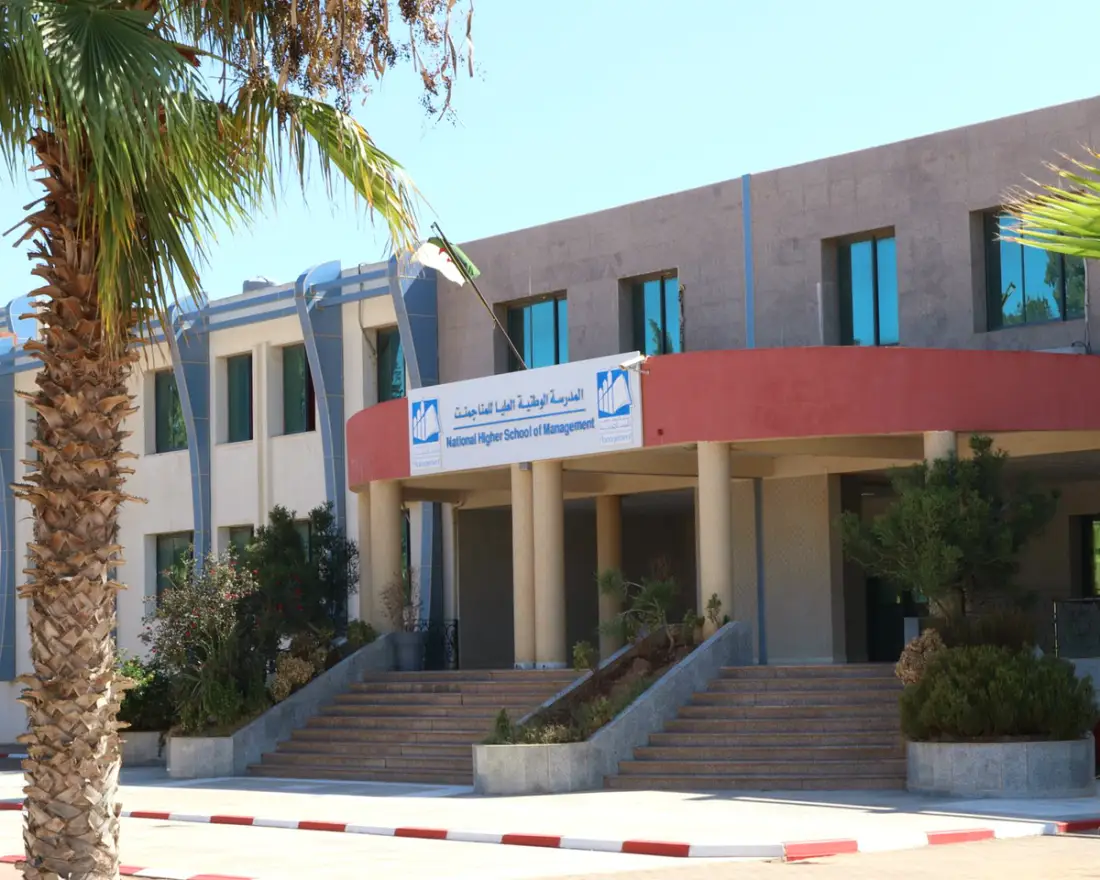
The main entrance of ENSM in sunlight, behind a palm tree

National Higher School of Management University Pole of Koléa, Tipaza

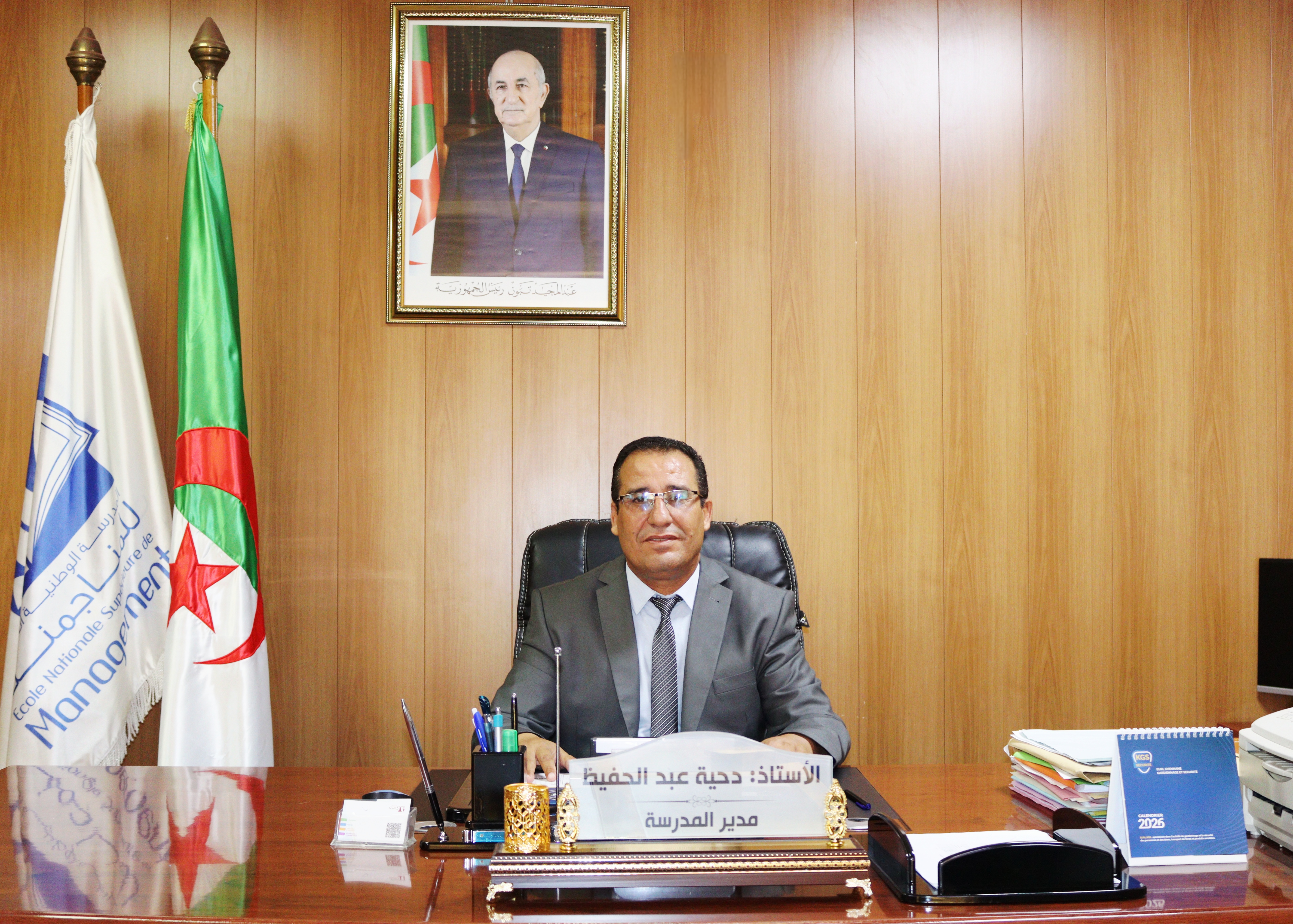
Portrait of Professor Dahia Abdelhafid
Prof. Dahia AbdelhafidDirector of the School

01 / DIRECTOR’S MESSAGE

Director’s Message

The National Higher School of Management (ENSM) occupies a strategic position and continues to evolve in harmony with the development of the Algerian state and its adaptation to global geostrategic dynamics. The School stands as one of the key pillars for the education and development of highly qualified professionals with dual competencies, thereby providing the labour market with managers operating at strategic, middle-management, and operational levels, both within national enterprises and multinational corporations.

Furthermore, the School has established itself as a key institution in the education and development of graduates specialized in entrepreneurship, leadership, and innovation. This further strengthens its distinctive identity, built around and promoted through the development of dual competencies.

The School has become an effective driver of the country's economic policies and actively contributes to their implementation through a diversified educational offering focused on management, governance, entrepreneurship, and innovation. In this respect, it has positioned itself as an essential stakeholder in all initiatives related to economic development and growth, while remaining continuously committed to meeting the requirements of the labour market and the needs of public authorities, particularly through its programmes in e-governance, transparency, and the fight against corruption.

The School benefits from a highly qualified and diverse human capital, enabling it to provide innovative and continuously evolving education through modern programmes that support the development of the country and its institutions.
Prof. Dahia AbdelhafidDirector of the School

02 / 2011–2024

The School’s History

At the beginning, the school opened its doors in temporary premises in central Algiers, while awaiting relocation to the University Pole of Koléa. The first class was launched in 2011, under the leadership of Professor Mohamed Chérif BELMIHOUB, offering three (3) Master’s programs: Organizational Management, Industrial Economics of Networks and Infrastructures, and a professional Master’s degree in Quality Management.

Additionally, the school organized PhD entrance exams in the aforementioned specialties, indicating its commitment to establishing solid academic research. Four years later, under the leadership of Professor Hasna Messaid, ENSM moved to the University Pole of Koléa. It expanded its programs with three new Master’s degrees in Human Resource Management, Strategic Management and Information Systems, and Marketing Management.

Three years later, ENSM introduced two new Master’s programs: Project Management and Entrepreneurship, and E-Government. A Master’s program in Supply Chain Management followed in 2019, together with new PhD training programs in Strategic Management and Information Systems.

In 2020, under the leadership of Professor Sidi Mohamed Sahel, ENSM enriched its academic programs with PhD training in Human Resource Management and Strategic Management and Information Systems, complementing the existing Organizational Management programs.

In 2022, the school added a Master’s in Corporate Financial Management. Under the leadership of Dr. Mounir BELALI, ENSM began an ambitious digital transformation, starting with the digitization of enrollment processes. His leadership and active listening helped create a collaborative environment for professors, students, and administrators. A Governance and Anti-Corruption program was also launched, illustrating the school’s commitment to ethical and accountable leadership.

By 2024, ENSM offered ten (10) Master’s programs, demonstrating remarkable growth in thirteen years. Its continued emphasis on communication, active participation, coaching, and the quality of training has helped form ambassadors who proudly uphold the school’s values. ENSM graduates now occupy strategic positions in Algeria and beyond, reflecting the rigor, discipline, and unwavering motivation at the heart of its educational approach.

Dr. Chafika LARRASDeputy Director for Teaching, Certificates, and Continuing Education

03 / IDENTITY & MISSION

What is ENSM?

The National Higher School of Management (ENSM) is a public school specialising in management. It offers first-cycle graduates complementary management expertise, with practical experience integrated into the curriculum. Its missions cover higher education, scientific research, innovation, monitoring, technology transfer and technological development. The brochures below present the school, its missions and values, programmes, research, partnerships and student life. They are available in French and English.

04 / STRUCTURE

Organizational Chart

Administrative organization chart of the National Higher School of Management. The supplied document is in Arabic.

Organizational chart

Loading PDF…

Download PDF 62.0 KB

05 / ADMINISTRATION

General Secretariat

In accordance with Executive Decree No. 16-176 of Ramadan, 9th, 1437 corresponding to June 14th, 2016 setting the standard statute of higher schools: The Secretary General is responsible for the administrative and financial management of the structures under his authority, as well as the technical services. In this capacity, he is granted delegation signing authority from the Director. In accordance with Joint Ministerial Decree of Jumada Ethania, 9th, 1439 corresponding to February, 25th, 2018 defining the administrative organization of the higher school and the nature and structure of its technical departments, the General Secretariat is entrusted with the following missions: Ensure the monitoring of career management for the school’s staff; Ensure the proper functioning of the technical services; Monitor the funding of research activities conducted by research units and laboratories; Propose and promote cultural and sports activities programs; Monitor infrastructure development projects and equipment procurement; Monitor the school's internal security plan; Ensure the provision of operational resources for the school’s structures and technical services, as well as the maintenance of movable and immovable property; Ensure the maintenance of the inventory records; Prepare and monitor the implementation of the school's budget proposal; Follow up on legal disputes before the judicial authorities. The Secretary General, to whom the Internal Security Office is attached, is assisted by: A Deputy Director for Personnel, Training, and Cultural & Sports Activities is assisted by: Head of Teaching Personnel Office; Head of the Administrative, Technical, and Service Personnel Office; Head of Cultural and Sports Activities Office; Head of Legal Affairs and Disputes Office A Deputy Director for Finance and Resources is assisted by: Head of Budget and Research Funding Office; Head of Public Procurement and Equipment Office; Head of Resources, Inventory, and Archives Office; Head of Hygiene and Maintenance Office. The Printing and Audiovisual Center, comprises the following divisions: Printing Division; Audiovisual Division. The Center for Systems, Media and Communication Networks, Distance Education, and E-learning, comprises the following divisions: Systems Division; Networks Division; Distance Education and E-learning Division.

06 / 360°

Virtual Tour

Drag to look around

Virtual school tour

Loading the 360° view…

Demonstration

Arrow keys to turn, + and − to zoom, 0 to return to the first view. Demonstration image. The school’s 360° photograph will be published from the administration area.

Visite virtuelle de l’école

Discover the ENSM campus at the Koléa University Pole on video.

07 / GOVERNANCE

Deliberative & Advisory Bodies

THE ADMINISTRATIVE BODIES OF THE SCHOOL Board of Directors In accordance with Executive Decree No. 16-176 of Ramadan, 9th, 1437 corresponding to June 14th, 2016 setting the standard statute of the higher school: The Board of Directors of the school, chaired by the Minister in charge of Higher Education or his representative, or by the relevant Minister or his representative. The Board of Directors deliberates on the following: The school project; The school’s development plans; Proposed programs for training and research activities; Proposed programs for national and international scientific exchange and cooperation; The annual report on training and research activities; Draft budgets and financial statements; Draft plans for human resource management; Acceptance of donations, bequests, grants, and various contributions; Acquisitions, sale, or the leasing of real estate; Loans to be contracted; Projects for the creation of subsidiaries and equity investments; The projected statement of the school’s own resources and the conditions governing their use as part of the development of training and research activities; The use, within the framework of the school's development plan, of revenues generated from equity investments and the creation of subsidiaries; Partnership agreements with all socio-economic sectors; The school's internal regulations; The annual activity report presented by the Director. The Board of Directors examines and proposes any measure likely to improve the functioning of the school support achievement of its objectives. Management Council In managing the school, the Director is assisted by a Management Council comprising the Deputy Directors, Heads of Departments, the school’s Secretary General, and the Library Director. The Management Council convenes, at least, once a month, with secretarial duties handled by the school’s Secretary General.
Board of Directors - Arabic and French source document Read PDF Download PDF

Board of Directors

In accordance with Executive Decree No. 16-176 of Ramadan, 9th, 1437 corresponding to June 14th, 2016 setting the standard statute of the higher school, the Board of Directors is chaired by the Minister in charge of Higher Education or his representative, or by the relevant Minister or his representative.

The Board of Directors deliberates on the school project, development plans, proposed training and research programs, scientific exchange and cooperation, annual activity reports, draft budgets and financial statements, human-resource plans, donations and contributions, real-estate transactions, loans, subsidiaries and equity investments, the school’s own resources, partnership agreements, internal regulations, and the annual activity report presented by the Director. It also examines and proposes measures likely to improve the functioning of the school and support achievement of its objectives.

Direction Council

In managing the school, the Director is assisted by a Management Council comprising the Deputy Directors, Heads of Departments, the school’s Secretary General, and the Library Director. The Management Council convenes at least once a month, with secretarial duties handled by the school’s Secretary General.

Members of the Board of Directors of the National Higher School of Management

  • Rouaski KhalidRepresentative of the Minister in charge of Higher Education and Scientific Research, Chairman
  • Aichouba HaniRepresentative of the Minister of National Defence
  • Saibi SamirRepresentative of the Minister in charge of Finance
  • Fechit Abou BakrRepresentative of the authority in charge of Public Service and Administrative Reform
  • Sakou AbdelkarimRepresentative of the Minister in charge of Public Works and Basic Infrastructures
  • Kenouni Kamel EddineRepresentative of the Minister in charge of Vocational Training and Education
  • Hammouche HassinaRepresentative of the Minister in charge of Irrigation
  • Bouzekria FatimaRepresentative of the Minister in charge of Energy and Mining
  • Abdelaziz MahmoudRepresentative of the Minister in charge of Trade and Export Development
  • Sennadj NassimaRepresentative of the Minister in charge of Post and Telecommunications
  • Hassas NassimaRepresentative of the Minister in charge of Tourism and Handicrafts
  • Chiker KarimaRepresentative of the Minister in charge of Housing, Urban Planning and the City
  • Ayad AhmedRepresentative of the Minister in charge of National Education
  • Bayou OmarRepresentative of the Minister in charge of Industry and Pharmaceutical Production
  • Amara RachidaRepresentative of the Minister in charge of Transport
  • Bachir TadjeddineRepresentative of the Group of Algerian Digital Actors (GAAN)
  • Karim OuamaneRepresentative of the National Waste Agency
  • Ferroukhi AmineElected representative of the Professors
  • Zerrouti MessaoudElected representative of the Professors
  • Boudebza DjahidaElected representative of the Associate Professors, Class B
  • Mezaache Al-YazidElected representative of the Associate Professors, Class B
  • Azzouz BilelElected representative of the Administrative, Technical, and Service Personnel
  • Kassi WahibaElected representative of the Administrative, Technical, and Service Personnel
  • Guemidi YacineElected student representative
  • Gougam AsmaElected student representative

Direction Council

Document unavailable.

Scientific Committees of Departments

Entrepreneurship in Project Management

Document unavailable.

Organizational Management

Document unavailable.

Regulatory Texts